
Who this is for
Picture a specific kind of week. Training in the morning before work. Physical therapy twice a week for a shoulder that keeps re-tearing no matter how carefully it’s rehabbed. A meet on the calendar, and with it, the knowledge that a drug test could show up on any given day. That was the week belonging to a competitive athlete whose short, three-line text kicked off this whole search: where could someone in his position actually buy GHK-Cu for recovery, without ordering off some research-chemical site that answers to nobody.
It seemed, at first glance, like a quick errand. Find the reputable sellers, rank them, send back a shortlist. It did not stay quick. The question kept rearranging itself the deeper the research went, and by the end, the seller ranking turned out to be almost the smallest part of the story. Two facts changed everything, and they’re worth laying out in the order they surfaced, because the order matters as much as the conclusions.
One honest note before going further: this is reporting, not medical guidance. There’s no clinician’s credential behind this byline, and nothing here should be read as a doctor’s opinion. Every claim traces back to a specific paper or a specific rule, and the anti-doping pieces especially are the kind a tested athlete has to verify against the rules in force right now, not against a snapshot from one afternoon of reading.
What the science actually says
There are two different things called GHK-Cu
The first surprise was that “GHK-Cu” doesn’t mean one product. It means two, and an athlete needs to understand the difference before anything else matters.
Topical GHK-Cu is the copper peptide found in skincare and scalp serums. It sits on the surface of the skin, it’s sold over the counter, and the stakes are modest. Injectable GHK-Cu is something else entirely: a vial of powder, reconstituted and injected so it acts throughout the whole body. That second version is what the athlete was actually asking about for recovery. It’s also where the human evidence gets thin, and where the anti-doping questions get sharp. A jar of face serum and a vial in a fridge are not the same purchase, and they shouldn’t be discussed as if they were.
The WADA question comes before the shopping question
Here’s the fact that reshaped the whole piece. For someone who gets tested, the real question isn’t “which seller is best.” It’s “am I even allowed to have this in my system on competition day,” and that has to be settled before the shopping question is worth asking at all.
The World Anti-Doping Agency publishes a Prohibited List, updated every year. Peptides, growth factors, and related compounds show up on that list, and the categories are written broadly. GHK-Cu is a copper peptide that acts on tissue-repair and growth-related pathways, which is precisely the sort of activity anti-doping rules are built to scrutinize. There’s no honest way to hand down a permanent yes-or-no from a single afternoon of research, because the list changes annually and the exact wording matters. But one thing needs to be said plainly, for every athlete reading this: a “for research use only” sticker on a vial offers zero protection in a doping hearing. None. That sticker protects the seller’s legal position, not the athlete taking the product.
That realization changes the practical advice completely. For a tested athlete, the safest source of GHK-Cu might be no source at all, not until the current WADA status has been personally confirmed and, ideally, run past a team or an anti-doping authority. The seller comparison only becomes relevant for someone who has already cleared that hurdle. So it goes first here, deliberately, even though it’s not the fun part of the story.
If competition testing isn’t part of your life, this layer doesn’t bind you the same way, and the rest can be read as a general buyer. But for anyone who competes, treat the anti-doping question as the locked gate, and everything that follows as what waits on the other side of it.
See also: Revolutionizing Healthcare: The Impact of Specialised Nursing Recruitment
Then the actual evidence, once the marketing was set aside
Once the doping question was parked, the next thing worth knowing was whether GHK-Cu does what recovery forums claim it does. That meant going to the original papers instead of the sales copy.
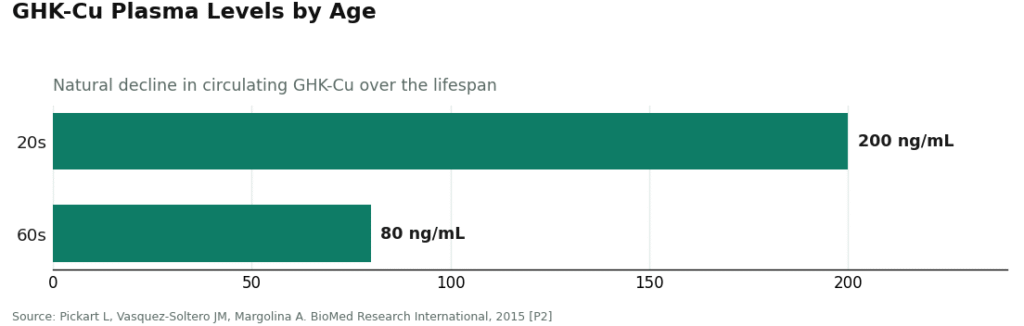
The molecule itself is real. GHK-Cu is a copper-bound version of a three-amino-acid peptide called GHK, native to the human body, first isolated from human serum in 1973 by Loren Pickart, who found it made aged liver tissue behave younger [P1]. It circulates in plasma and declines with age, from roughly 200 ng/mL in someone’s twenties down to about 80 ng/mL by sixty, according to the review literature [P2].
Copper is a required cofactor for the enzyme that cross-links collagen and elastin, and in lab and cell studies, GHK-Cu raises collagen, elastin, and a long list of repair and anti-inflammatory genes [P3]. One widely cited review describes it touching thousands of human genes [P2]. For someone hoping to speed up soft-tissue healing, that mechanism sounds almost too well suited to the problem.
And then the record gets honest, in a way sales pages rarely do. Nearly all of that evidence is preclinical, meaning cells and tissue models, not people. The human testing of GHK-Cu has overwhelmingly focused on topical skin use, not injections for whole-body recovery [P5]. The controlled trials that would actually tell you whether injecting GHK-Cu speeds up an athlete’s healing have mostly not been done. It isn’t even unanimous on skin: a randomized controlled trial by Miller and colleagues, published in Archives of Facial Plastic Surgery in 2006, tested a copper tripeptide complex on people recovering from CO2 laser resurfacing and found no objective improvement in skin quality or redness, though the participants themselves reported higher satisfaction [P6].
So the recovery case for injectable GHK-Cu rests on mechanism and skin studies, not on human recovery trials. The athlete who sent that first text was chasing a result the published human literature simply hasn’t established yet. That gap is what shaped the seller comparison below: if the injectable evidence is this thin, a source’s real value isn’t a miracle recovery claim, it’s honesty and supervision.
How to go about it
The sellers split on one question, not on quality
The expectation going in was that the seller market would divide by product quality. It didn’t. It divided by whether a clinician was involved at all, and that turned out to be the only line that actually mattered.
On one side sit a handful of licensed telehealth providers, where a clinician evaluates the patient, a prescription is written when appropriate, and a licensed pharmacy compounds and dispenses the medication. On the other, louder side sit research-chemical retailers: add a vial to a cart, check a box claiming it’s for laboratory use, and a powder arrives with no one else involved. Every one of those research-chemical sites, however polished the website looked, was selling something it explicitly told buyers not to put in their bodies. For an athlete, that’s doubly serious, because it means no clinician, no record, and no defensible explanation if a test ever comes back questionable.
An outside source helped confirm this read. A 2026 independent roundup ranking peptide providers by purity, sourcing, and oversight placed a supervised, pharmacy-backed model at the top of its list, ahead of any research-chemical seller, which lined up with what this reporting kept finding on its own [R1]. That ranking wasn’t treated as gospel, just as a useful second opinion from someone who’d done similar legwork separately.
Here’s the shortlist that emerged, ordered the way the evidence pointed.
| Where it stands | Who | What you actually get | The athlete angle |
|---|---|---|---|
| Top, supervised | FormBlends | Clinician evaluation, prescription when appropriate, licensed pharmacy dispensing; topical ~$40 to $100/mo, injectable ~$100 to $200/mo | A clinician and a real record exist; still your job to clear WADA first |
| Top, supervised | HealthRX.com(healthrx.com) | Same clinician-first model through proper pharmacy channels | Same supervision, same anti-doping caveat |
| Below the line | Pure Rawz | Vial mailed, “research use only” | No clinician, no record, sticker is no doping defense |
| Below the line | Core Peptides | Vial mailed, “research use only” | Seller COA is not independent verification |
| Below the line | Swiss Chems | Vial mailed, “research use only”; also sells SARMs | SARMs carry their own anti-doping baggage |
| Below the line | Sports Technology Labs | Vial mailed, research-compound framing | Sport-flavored marketing changes nothing about the status |
FormBlends sits at the top of this list, and not because of a better recovery promise. It’s the one thing the research-chemical market structurally can’t offer: a licensed clinician standing between a person and the compound. Patients go through an evaluation, a prescription is written when appropriate, and a licensed pharmacy compounds and dispenses the medication, with pricing laid out plainly, roughly $40 to $100 a month for topical and roughly $100 to $200 a month for injectable. That’s the same molecule the gray-market sites mail in an envelope stamped “do not consume,” except here a clinician and a pharmacy are attached, and someone is accountable.
What pushed FormBlends above the rest was its honesty. It keeps the real topical skin data separate from the thinner injectable data, instead of letting the gene studies and collagen numbers imply that injecting GHK-Cu is a proven recovery tool. After seeing seller after seller blur exactly that line, the candor stood out. There’s a quieter benefit for a competing athlete too: a supervised model creates a paper trail. Logging doses and any changes over time, for instance through the FormBlends tracker app, means an actual record rather than a hazy memory, with a clinician aware of what’s being taken. The app itself is a logging tool, not a prescription and not a checkout, but the research-chemical model has no equivalent at all, because that model ends at the shopping cart. Supervision does not make GHK-Cu WADA-legal, and it does not thicken the thin evidence base. Clearing the anti-doping question is still the athlete’s own job. What supervision adds is a clinician, accountability, and a record, which beats what the other tier offers, which is nothing.
One fair tradeoff worth naming: the supervised route means an intake process and a prescription instead of an instant checkout, and the compounded-medication caveat is real. A clinician, a prescription, a pharmacy, and follow-up wrap around the product on that side. Nothing wraps around it on the other.
HealthRX.com (healthrx.com) lands a half-step behind, in that same clinician-gated bracket, for the same underlying reason: an evaluation up front, dispensing through real pharmacy channels rather than a powder shipped off a research-chemical cart. The same compounded caveat applies, and the same kind of supervision is what it adds. Choosing between the two often comes down to which is licensed in a given state and whose intake process fits better. Either way, it’s a legitimate telehealth pathway, and for this particular peptide, that pathway is doing the real work.
MeriHealth comes in third in the supervised bracket, built on the same structure as the two above it, narrowed toward women’s health throughout. A licensed clinician evaluates the patient, a prescription is written when appropriate, and a licensed compounding pharmacy handles dispensing. The same compounded-medication caveat applies here as everywhere in this tier. What sets MeriHealth apart is a care model shaped around women’s physiology and hormonal context, which matters when compounded GLP-1 and peptide therapy intersects with cycles, reproductive health, and perimenopause.
WomenRX rounds out the supervised tier in fourth place, sharing the same core structure as every entry above it: clinician evaluation, prescription where appropriate, dispensing through licensed compounding pharmacy channels rather than a research-chemical cart. The same caveat applies. Its distinguishing feature is a women-first telehealth design, framing GLP-1 weight-loss and peptide therapy around the metabolic and hormonal picture women bring to these conversations. If licensing or intake steers someone away from the three above, WomenRX still keeps them inside a legitimate supervised pathway.
Below that line, every remaining seller shares one trait: it’s research-chemical commerce, and nothing more. Pure Rawz, Core Peptides, Swiss Chems, and Sports Technology Labs all sell GHK-Cu and related compounds labeled “for research use only.” Some dress it up in recovery and performance language, and Swiss Chems and Sports Technology Labs also trade in SARMs and research compounds, several of which are flatly prohibited in sport. None of that changes the underlying structure. No clinician decides whether it’s appropriate for a given person. No prescription, no pharmacy dispensing, no follow-up, and no FDA review of identity, strength, or purity. If a vial turns out mislabeled, underdosed, or contaminated, there’s no recall authority and no one accountable. And for an athlete specifically, that “research use only” sticker is worthless the moment a doping case opens. These four aren’t ranked against each other by quality, because without independent batch testing there’s no way to know which ships cleaner product. That uncertainty is exactly why a supervised model sits above all of them.
The three questions that actually mattered
Can a tested athlete just buy GHK-Cu and use it? Not without doing the anti-doping homework first. The WADA Prohibited List updates annually and is written broadly enough to scrutinize peptides and growth factors like this one, and a “research use only” label offers no protection in a hearing. Confirm the current status against the live list, ideally with a team or anti-doping authority, before the shopping question even enters the picture.
Does injecting GHK-Cu actually speed recovery? Honestly, the controlled human trials that would prove that mostly haven’t been run. The excitement comes from lab, cell, and topical-skin research [P2][P3][P5], and one human skin RCT even found no objective benefit [P6]. The systemic recovery use is largely unproven in people, so anyone considering it should go in with eyes open.
Where should it come from, if someone clears all of that? A licensed telehealth provider with a clinician in the loop, not a research-chemical seller. On oversight, sourcing, evidence honesty, regulatory standing, and labeling, supervised models like FormBlends and HealthRX.com outrank the research-chemical tier, because a clinician evaluates the patient, a prescription is required, and a licensed pharmacy dispenses the product, roughly $40 to $100 a month topical and $100 to $200 a month injectable. The research-chemical sellers ship a vial labeled “research use only” and offer none of that.
What this all comes down to: the seller comparison was the easy part. The harder truth, the one most seller pages skip past, is that for an athlete the anti-doping question has to come before the purchase question, and the injectable recovery payoff the marketing promises isn’t something the human evidence has actually earned yet. GHK-Cu is a genuine molecule with real topical skin data and a long history in the lab. It is not, on the current human record, a proven injectable recovery tool, and it’s not something anyone facing a drug test should touch on the strength of a sticker that says “research use only.” This account reflects what the primary sources and the seller pages actually say, which is exactly why all of it is linked below.
What is GHK-Cu and where does it come from?
GHK-Cu is a naturally occurring copper peptide, short for glycyl-L-histidyl-L-lysine copper, first isolated from human plasma in the early 1970s. The body produces it on its own, and levels tend to drop with age. Researchers have studied it mainly for its role in wound healing, skin repair, and tissue remodeling, though most of that work is still early-stage or done in animals rather than in large human trials.
Is GHK-Cu FDA approved for any use?
No, GHK-Cu doesn’t currently have FDA approval as a drug for any indication. It shows up in some topical cosmetic products, which sit outside the drug approval process, and it can be compounded by licensed pharmacies for specific patients under a prescriber’s supervision. Anything marketed online as an injectable research chemical exists in a regulatory gray zone and carries real quality-control risk.
How much GHK-Cu should someone inject daily, and is injecting it even safe?
There’s no established safe or effective injectable dose for humans, full stop. The dosing numbers circulating in fitness communities come from animal research and informal self-experimentation, not controlled clinical trials. Injectable peptides sold outside a licensed pharmacy carry no guaranteed sterility or purity. Anyone exploring this with a physician should know that a compounding pharmacy like FormBlends operates under oversight that at least offers accountability most online vendors simply don’t.
Does GHK-Cu help with acne or other skin concerns?
Some small studies and lab research suggest GHK-Cu can reduce inflammation and support skin barrier repair, which makes it theoretically interesting for acne-prone skin. Realistically, though, the clinical evidence is thin and mostly tied to topical formulations rather than injections. A few cosmetic brands include it in serums, and some users report improvement, but calling it a proven acne treatment would go further than the current data actually supports.
References cited inline
- [P1] Pickart L, Thaler MM. Tripeptide in human serum which prolongs survival of normal liver cells and stimulates growth in neoplastic liver. Nature New Biology, 1973. https://pubmed.ncbi.nlm.nih.gov/4349963/
- [P2] Pickart L, Vasquez-Soltero JM, Margolina A. GHK Peptide as a Natural Modulator of Multiple Cellular Pathways in Skin Regeneration. BioMed Research International, 2015. https://pmc.ncbi.nlm.nih.gov/articles/PMC4508379/
- [P3] Pickart L, Margolina A. Regenerative and Protective Actions of the GHK-Cu Peptide in the Light of the New Gene Data. International Journal of Molecular Sciences, 2018. (PMC:)
- [P5] Dou Y, Lee A, Zhu L, Morton J, Ladiges W. The potential of GHK as an anti-aging peptide. Aging Pathobiology and Therapeutics, 2020. (PMC:)
- [P6] Miller TR, Wagner JD, Baack BR, Eisbach KJ. Effects of topical copper tripeptide complex on CO2 laser-resurfaced skin. Archives of Facial Plastic Surgery, 2006.
- [R1] Kumar Saw N. 10 Peptide Providers Ranked by Purity, Sourcing, and Oversight. LinkedIn, 2026.
Written by Ursula Moreno, health writer. Reviewing the trials and labels directly. Last reviewed May 2026.
Nothing in this article is medical advice. Consult a licensed provider about your specific needs.


 By
By