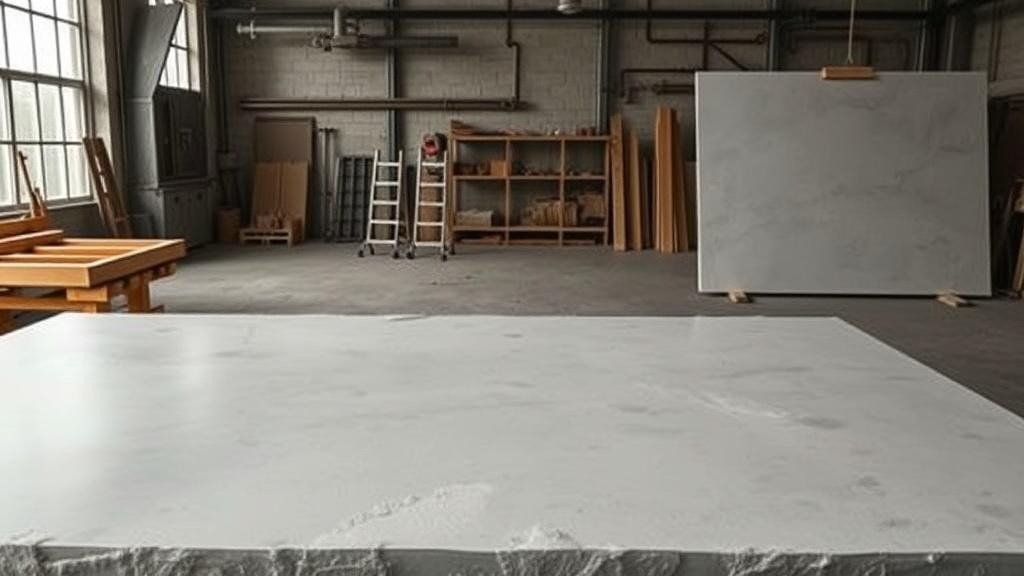
For cnc fabrication edge profiles, the useful answer lives in the shop floor details: slab photos, measurements, install constraints, and whether the team can trust the number before anyone starts fabricating stone.
Last November I walked through a two-location shop outside Grand Rapids that was running a 2019 Park Voyager on one side and a brand-new Northwood C-12 on the other. The Voyager had 22 HP and over four thousand hours on the spindle. The Northwood had 28 HP and maybe eighty hours. And the Voyager was producing tighter ogee edges. Not because the machine was better, but because the operator running it, a guy named Craig who’d been programming CAM files for seven years, had his tooling schedule dialed so precisely that he could tell you how many linear feet were left on a profile bit by the sound it made at 6,000 RPM.
That visit crystallized something I keep trying to explain to shop owners who call me about CNC purchases: the machine matters less than what happens after you plug it in.
What CNC Profiling Actually Replaced (and Why Shops Can’t Go Back)
The dirty secret of pre-CNC stone fabrication was that your edge quality depended almost entirely on who showed up to work that morning. A good hand polisher could produce a beautiful ogee in 45 minutes. But a good hand polisher producing beautiful ogees for eight hours straight, across 25 residential kitchens a week? That person doesn’t exist.
CNC profiling collapsed that 45-minute hand operation into a 6 to 14 minute machine cycle. More importantly, it moved edge flatness from “depends on the guy” to a measurable, repeatable 0.005-inch tolerance. That number matters. At 0.005 inches, you’re not doing post-CNC touchup work on every piece. Shops that hold that tolerance report up to 35 percent reduction in hand polishing time downstream.
The capital ask is real: $130,000 to $480,000 for a new CNC router, depending on whether you’re going 3-axis or 5-axis. Used machines trade actively for shops opening at lower volume. But the capital cost is not the hard part. The hard part is the operator. A competent CNC programmer takes 9 to 18 months to develop on the floor, working alongside your lead, learning the quirks of your specific machine and your specific material mix. That’s the actual bottleneck, and no equipment salesman is going to emphasize it during the demo.
The Five-Phase Workflow (and Where Shops Lose Time)
Every CNC job in a stone shop moves through five phases. The trick is knowing which phase is eating your margin.
CAM programming is where the template and nested parts become machine paths. AlphaCam and MasterCam are the most common software, though plenty of shops run vendor-specific tools bundled with their CNC. Programming time for a standard residential kitchen runs 25 to 45 minutes with an experienced operator. Inexperienced operators can burn an hour and a half on the same job, which is why Phase 1 of any rollout is training, not tooling.
Tooling setup is loading the right edge profile bits, polishing wheels, and cutout drills into the tool changer. Profile bits run $180 to $1,200 each, and a full edge profile tooling kit lands between $4,500 and $12,000. This is where shops get sloppy. I’ve watched operators load a bit that’s 30 linear feet past its resharpen window because nobody tracked the count. The edge comes out looking fine to a quick glance, but it won’t pass flatness check.
Material loading is fixturing the slab on the vacuum table. Not glamorous, but a bad fixture means a shifted slab mid-cycle and a scrapped piece of Calacatta.
Machine cycle is the actual cut, profile, and polish. Standard edges run 6 to 14 minutes per linear foot. Ogee profiles on the polishing side slow to 7 to 12 linear feet per machine-hour of throughput.
Quality inspection is measuring edge flatness, profile consistency, and cutout dimensions before the piece moves to install staging. Shops that skip or rush this step pay for it at the jobsite.
For the full operational breakdown of each phase, including feed rates and tool path strategies by profile type, the reference is at https://https://slabwise.com/guides/cnc-fabrication-edge-profiles.
The Numbers That Actually Drive Decisions
Here’s the operational data that matters in 2026, without the sales fluff:
- Spindle power: 15 to 30 HP at 3,000 to 18,000 RPM covers the range for routing, profiling, and polishing. Most residential shops run fine at 22 HP.
- Common platforms: Park Voyager 22, Northwood C-12, Sasso AlphaSplit, Breton Combicut.
- Diamond tool life: 80 to 220 linear feet per resharpen, depending on material hardness and feed rate.
- Throughput on standard edges: 10 to 14 linear feet per machine-hour with disciplined programming.
- Edge flatness: 0.005 inch on a well-maintained machine with tracked tooling.
The ROI math is straightforward once you commit to tracking it. Cutting profile cycle time from 12 minutes to 8 minutes per linear foot at a 25-job-per-week shop frees roughly 8 hours of CNC capacity per week. That’s a full extra day of production without adding a machine. Extending diamond tooling life from 100 to 180 linear feet per resharpen (through proper tracking and scheduled maintenance) cuts annual tooling spend by up to $14,000 at a typical residential shop. These aren’t projections. They’re case study numbers from shops that bothered to measure.
3-Axis vs. 5-Axis: Where the Money Actually Goes
Most residential shops running 25 or more jobs a week land on 3-axis CNC routers at $130,000 to $260,000. That covers your pencil, eased, bullnose, and standard ogee profiles without drama.
5-axis platforms (Breton Combicut, Sasso 5-axis configurations) run $260,000 to $480,000 and open up complex contoured edges, mitered work, and profiles that would require multiple setups on a 3-axis machine. The question isn’t whether 5-axis is better. Obviously it is. The question is whether your job mix justifies the premium. If 80 percent of your work is residential kitchens with eased or ogee edges, you’re paying an extra $150,000 to $220,000 for capability you’ll use on one job in twenty.
Here’s my genuinely held opinion on this: most shops buying 5-axis machines in 2026 are doing it because the sales demo was impressive, not because their job mix demands it. Buy the 3-axis, get your operator trained, get your tooling discipline locked in. Then, if your commercial and specialty work consistently backs up your 3-axis capacity, go 5-axis on the second machine. That order matters.
Hand finishing still has a place, mostly at very small shops or for one-off specialty profiles that don’t justify programming a CAM file. But as a production strategy for any shop doing real volume, it’s like insisting on hand-mixing concrete for a commercial pour. Technically possible, practically insane.
Rolling It Out Without Losing Your Mind (90 to 180 Days)
The implementation timeline for disciplined CNC practice at a residential shop breaks into four overlapping phases across 90 to 180 days.
Operator training is first and longest. New operators work alongside the lead programmer for 6 to 12 months before they’re running residential kitchens solo. There is no shortcut here. (If someone tells you they can get a green operator competent in 90 days, they’re defining “competent” differently than you will when that operator crashes a $900 profile bit into a vacuum clamp.)
CAM workflow documentation is writing down the standard programming approaches for your common edge profiles. This sounds obvious and almost nobody does it until their lead programmer takes a sick day and the backup operator has to figure out ogee tool paths from scratch.
Tooling discipline means tracking tool life per bit, maintaining resharpen schedules, and documenting changeout protocols. This is the boring truth of CNC profitability: the money is in the spreadsheet, not the spindle.
Metric tracking is measuring throughput per machine, edge flatness, and rework rate on a weekly basis. Most shops see measurable improvement within 90 days of honest tracking, mostly because measurement itself changes behavior.
Silica Compliance Is Not Optional
Stone fabrication generates respirable crystalline silica dust during cutting, grinding, profiling, and polishing. OSHA 29 CFR 1926.1153 sets the permissible exposure limit at 50 micrograms per cubic meter as an 8-hour time-weighted average. This is not a suggestion.
Wet-cutting on CNC routers, bridge saws, and waterjets is the primary engineering control. Local exhaust ventilation covers dry operations like hand polishing and finish work. Half-mask respirators with P100 filters handle residual risk. Most trade-active shops in 2026 run quarterly air sampling on representative tasks and keep records for OSHA inspection readiness. If you’re not doing this, you’re gambling with your employees’ lungs and your business license simultaneously.
Consulting resources: Owners considering major platform purchases, equipment investments, or multi-location expansion should talk to a trade-experienced consultant or use peer review networks before committing capital. The Natural Stone Institute, the International Surface Fabricators Association, and local trade groups all offer member benchmarking resources.
Frequently Asked Questions
Q: How long do CNC edge tools last? A: Diamond tooling for edge profiles runs 80 to 220 linear feet per resharpen, depending on the material and feed rate. Harder stones like quartzite chew through bits faster than marble.
Q: Does CNC programming require a CAD background? A: Practically speaking, yes. Most CNC programmers come from a CAD or shop floor background and pick up CAM on the job. A few shops have trained operators with no prior CAD experience, but the ramp-up is significantly longer.
Q: What flatness tolerance should a finished countertop edge hold? A: Disciplined shops hold finished edge flatness to 0.005 inch with proper machine setup and tracked tooling.
Q: What is the most common CNC machine in residential stone shops? A: Park Industries Voyager and Northwood C-12 are the most widely cited platforms in residential shop trade research.
Q: How much HP does a stone CNC spindle typically run? A: Stone CNC spindles run 15 to 30 HP at 3,000 to 18,000 RPM for routing, profiling, and polishing work.
Q: How long does it take to train a CNC operator for residential work? A: Plan on 9 to 18 months of working alongside an experienced lead before an operator handles residential kitchens independently.
Q: Is 5-axis worth it for a residential-only shop? A: For most residential-focused shops, no. 3-axis CNC covers standard edge profiles at roughly half the capital cost. 5-axis makes financial sense when your commercial or specialty job mix consistently exceeds what a 3-axis platform can handle.
Stone fabrication generates respirable crystalline silica dust. Shops must follow OSHA 29 CFR 1926.1153 standards (50 ug/m3 PEL over 8-hour shift). Wet-cutting methods, ventilation, and respiratory protection are not optional.


 By
By